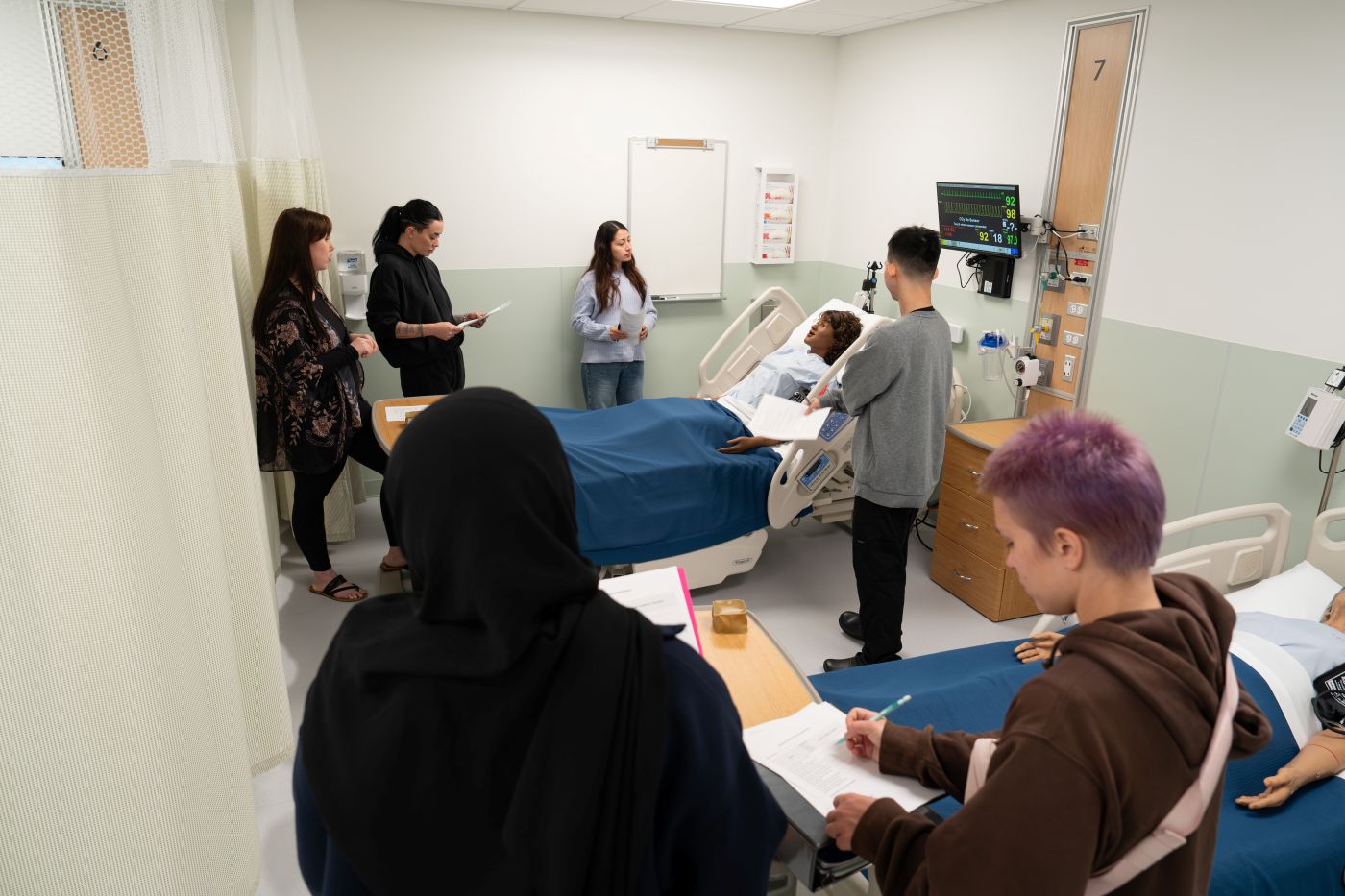
This fall, Normandale Community College became one of the first community colleges in the region to dedicate facility space around Interprofessional Education (IPE) in Healthcare.
The opening of the Center for Interprofessional Education in Healthcare gave Normandale Health Sciences programs the rare opportunity to build and develop a facility where Community Health Workers, Dental Hygiene, Exercise Science, Nursing and Public Health students could learn and train to work collaboratively through the knowledge they gained in their respective course areas.
When Normandale Community College Dean of Health Sciences Dr. Sara Traylor prepared for the opening of the space by meeting with IPE colleges and universities with interprofessional facilities last year, one of the challenges those programs mentioned was finding ways to fit IPE activities into current course scheduling structure.
“When I met and talked with directors of other IPE programs, a common theme was that it is really hard to implement IPE activities in your current course scheduling structure,” said Dr. Traylor. “All of the recommendations I heard were that there needed be a dedicated day or days to these activities. That is what we chose to do.”
On the two IPE days, groups of six to nine students from all of the different Health Science degree areas worked in multi-disciplinary groups rotating between three areas where the participated in different IPE-related activities. Those activities included:
The main objectives of the activities were to focus on the four key areas of IPE that include ethics/values, teamwork and collaboration, roles and responsibilities/professionalism, and communication.
“It is not about the skills of each profession, but how the students bring their professional skills to the situation to work together and accomplish a shared goal,” said Dr. Traylor.
Students from the Health Sciences degree areas appreciated the opportunity to work and learn from each other through these IPE Day activities.
“It was nice to see the interplay that we usually wouldn’t think about because we are so focused on the areas we are studying,” said Monique, a Nursing student at Normandale. “We are not always realizing how we can interact with the other disciplines as much, so it is helpful to see what their roles would be in a similar situation.”
Normandale Community College Dental Hygiene Instructor Megan Smith, who is part of Normandale’s IPE Committee, believes it is important for students to learn and understand how they work and collaborate with other healthcare professionals outside of their area of study.
“I think the IPE Days helped our students learn about each other’s healthcare professions,” said Smith. “When we got in groups like this, students realized that while the scope of their work is important there are other things they need to consider and think about. Having those conversations with each other really forced them to work as a team. When you put students from all of the different fields together, you got a vast array of knowledge and they learned a lot from each other.”
Through working together students gained perspectives that not only help them understand IPE principles, but can also help them as they continue to prepare for jobs in their respective fields.
“The Home Health Room scenario was realistic in that our patient was asking us a lot of questions back about the information we were providing,” said Lazaro, a Dental Hygiene student. “There were times we had to figure out how to answer the patient’s questions as a group. That is definitely something we will all experience in a work environment, and it is good preparation to see the different information and roles we all had.”
Normandale Community College Community Health Worker Instructor Cindy Carow-Schiebe, who is also part of Normandale’s IPE committee, mentions that the interprofessional training and ideas have consistently been an important part of the Community Health Worker curriculum and training. One aspect of the IPE Days she appreciates is the focus on the variety of was to care for the patient.
“Competencies for IPE focus on communication, trust and ethics,” said Carow-Schiebe. “When the professions work together in this setting, they are not just focusing on their scope of practice they are working on how to communicate with a patient together. The focus is on what the students are doing to help the patients feel like they can be trusted and provide help. If you don’t have those skills and the trust with a patient first, it doesn’t matter what you tell them related to your scope of practice because they will not listen. Getting into the compassion aspect of working with patients is where this really helps, and it is an important focus. The IPE Days highlight the compassion part, and emphasizes that it is going to be the opening to care.”
For some of the students it was their first exposure to the concepts of interprofessional ideas and training. Agustin, who is high school student pursuing exercise science with the goal of being a physical therapist, appreciated the fresh perspective.
“This is the first time I am experiencing something like this,” he said. “I really want to be a physical therapist, and I am used to helping people my age, because I help people in sports through my current experiences. The Home Health Room case study helped me realize I have to approach things differently and be more understanding of the overall situation. It prepared me a lot.”
Dr. Traylor has heard positive feedback from both students and faculty, and Normandale looks forward to future versions of IPE days to use the feedback, surveys and industry advice to continue to add to the interprofessional experiences to prepare students for the workforce.
 top