When browsing through the list of interprofessional health program facilities around the nation at the National Center for Interprofessional Practice and Education website, it stands out how rare Normandale Community College’s Center for Interprofessional Education in Health Care will be for two-year colleges.
The website highlights a list of 192 facilities dedicated to the interprofessional practice and education. The majority of the programs are associated with universities in 48 of the 50 states. Only one community college (Harper College in Illinois) is currently on the list.
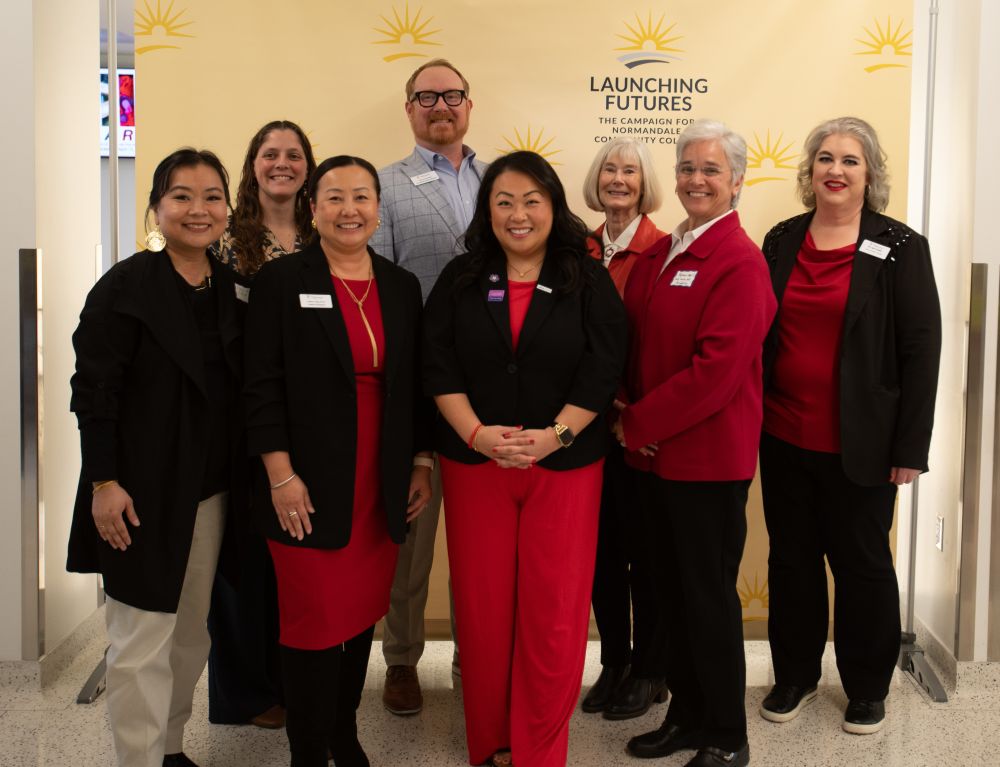 This highlights the unique nature of Normandale’s commitment to interprofessional education by privately funding the renovation in the second floor of its Science Building for the Center for Interprofessional Education in Healthcare (also known as the “Healthcare Education Hub”) project.
The Center for Interprofessional Education in Healthcare is designed to create a modern learning environment where students train together the way healthcare teams work in the field.
Students from nursing, dental hygiene, community health, exercise science, and public health programs learn together in shared simulation labs, telehealth‑enabled spaces, and realistic clinical environments. This integrated, hands‑on approach builds teamwork, communication, and whole‑person care skills, ensuring graduates are confident, collaborative, and fully ready for practice on day one.
As one of only a handful of community colleges nationwide creating a fully integrated interprofessional education center, Normandale is setting a new standard for accessible, collaborative, and industry‑aligned healthcare training at a two-year cost.
Leading the Way to Meet Workforce Needs
One of the important reasons for the project was to help Normandale better meet the healthcare workforce needs of the state.
The Nursing Program had outgrown its lab and simulation spaces, which limited the size of the cohorts that could go through the program and the number of graduates Normandale could send into the workforce.
Although Normandale’s Dental Clinic provides state‑of‑the‑art facilities and supports over 3,000 community patient visits each year, the Dental Hygiene Program lacked adequate classroom and simulation space with the instructional flexibility required to sustain and expand program enrollment.
Both programs do an excellent job producing quality graduates to send into the workforce. The Dental Hygiene program routinely has 100% of its graduates pass the Dental Licensure exams, and the Nursing Program has a little over 94% pass rate of the National Council Licensure Examination (NCLEX) between 2021-25, which is the highest of any two-year college in Minnesota during that timeframe. The Center allows Normandale the opportunity to increase space for its faculty and students, raising the quality of the learning spaces for these cohorts without sacrificing the quality instructions they receive.
Oral Health Lab increases program Flexibility for the Dental Hygiene Program
The new Oral Health Lab features built‑in lab stations equipped with manikin heads and functional simulation units that mimic the clinical set up. Each unit is equipped with the typical dental unit set up. A similar instructor station with video equipment allows the instructor to showcase live demonstrations to each student station which supports both skill development and integrated lecture‑and‑practice instruction.
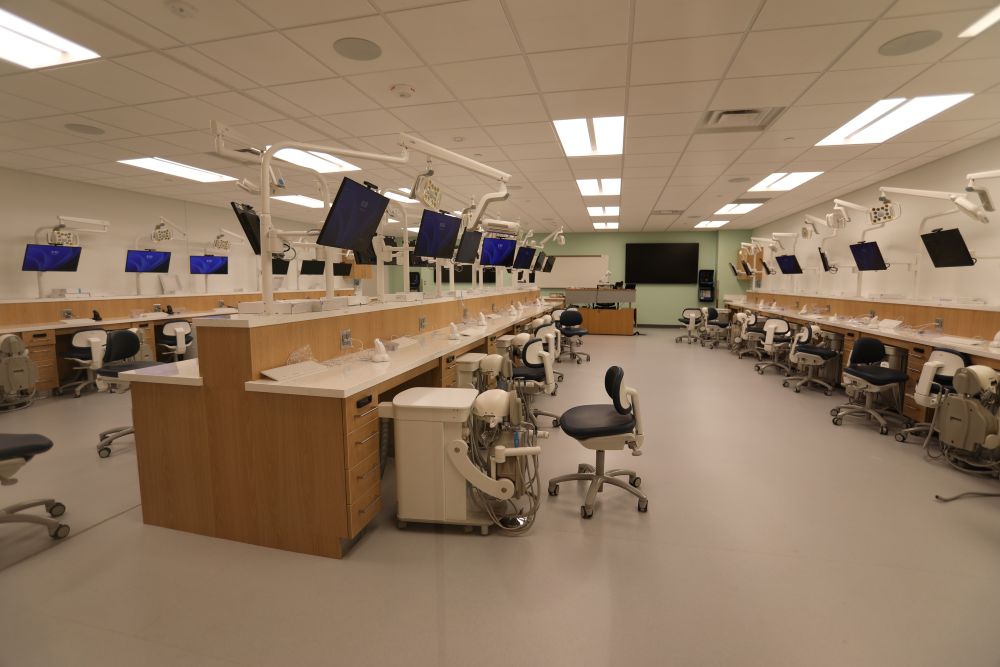 In the past, there had been only one classroom space where dental hygiene courses have been offered. Having the Oral Hygiene Lab, Dental Clinic and the classroom allows multiple spaces at once where classes can be taught for different levels of students going through the program.
While the existing Dental Hygiene Clinic has long provided an excellent environment for students to learn and refine their clinical competencies, students previously had to utilize the clinic space as simulation space by attaching manikin heads to the dental unit chairs. This created logistical challenges, limited instructional flexibility, and provided barriers to enrollment increase.
With the addition of the Oral Health Lab, alongside the existing Dental Clinic and classroom, the program now has multiple dedicated instructional environments that can be used simultaneously for different cohorts and levels of students progressing through the curriculum. This expanded instructional flexibility positioned the Dental Hygiene Program to increase their cohort size from 24 to 30 students, which is a significant achievement towards helping address the workforce shortages in the profession.
Flexible Nursing Lab Spaces
Along with the existing Nursing Lab, Normandale adds an eight-bed Nursing Skills Lab, an eight-bed Ambulatory Simulation Space and Simulation Labs that will have two control rooms and four flex labs.
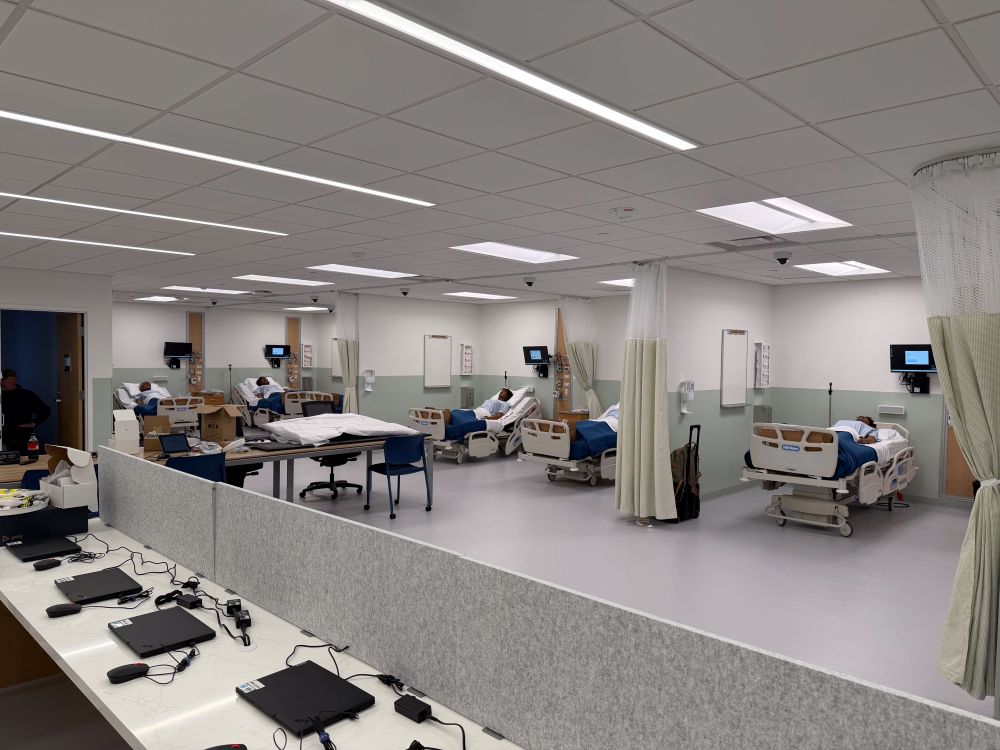 The skills lab has eight beds with non-high-fidelity manikins that will provide the opportunity for students to learn foundational clinical skills without computerized physiological responses. The space is a standard lab set up similar to the Nursing Lab that has existed and is used in a variety of ways.
“With our cohort numbers increasing, we were outgrowing the one current lab space,” said Dr. Traylor. “This provides additional space for our current nursing students, and gives more flexibility when it comes to open lab time for students to practice their skills outside of classroom and lab time. The skills lab will help us have the spaces to expand cohort numbers in the future. Having a second lab area also helps to meet the growing demand for Nursing Assistant courses in a space like this, while still being able to teach Nursing courses in the other lab space.”
The Ambulatory Simulation Space is also an eight-bed unit, but it will have high-fidelity manikins that are advanced and have a computer-driven full-body simulator that realistically mimics human anatomy and physiological responses. It will also have a control station, which will have eight different laptops with each one running a different manikin space.
“In this space, you could potentially have eight manikins running at the same time with eight students, or you could have a whole clinical group or two clinical groups running through a scenario,” said Dr. Traylor. “This space will also be used for interprofessional activities like having small groups of nursing, dental hygiene, and health science students working together through a scenario.”
There is also a Flex Simulation Lab, which will have two control rooms and four flex lab areas with one bed and one manikin in each area. Previously, there was one control room with two bed setups, but it only had a half-wall divider which made it difficult for students working on different scenarios in the same area. With this setup, there will be two computers that can control two manikins. The separate spaces allow the opportunity to have four scenarios going on at once.
“During the fall and spring semesters, the simulation labs are running eight hours per day,” said Dr. Traylor. “This new setup allows for more flexibility. “This will be a big part of accommodating spaces for students as we increase cohort sizes.”
As you walk through these newly built spaces, it quickly becomes apparent the amount of flexibility and high-level facilities health sciences students will have at their finger tips when they come to Normandale through the Center of Interprofessional Education in Healthcare.
Purposeful Design to Simulate Workplace Experiences 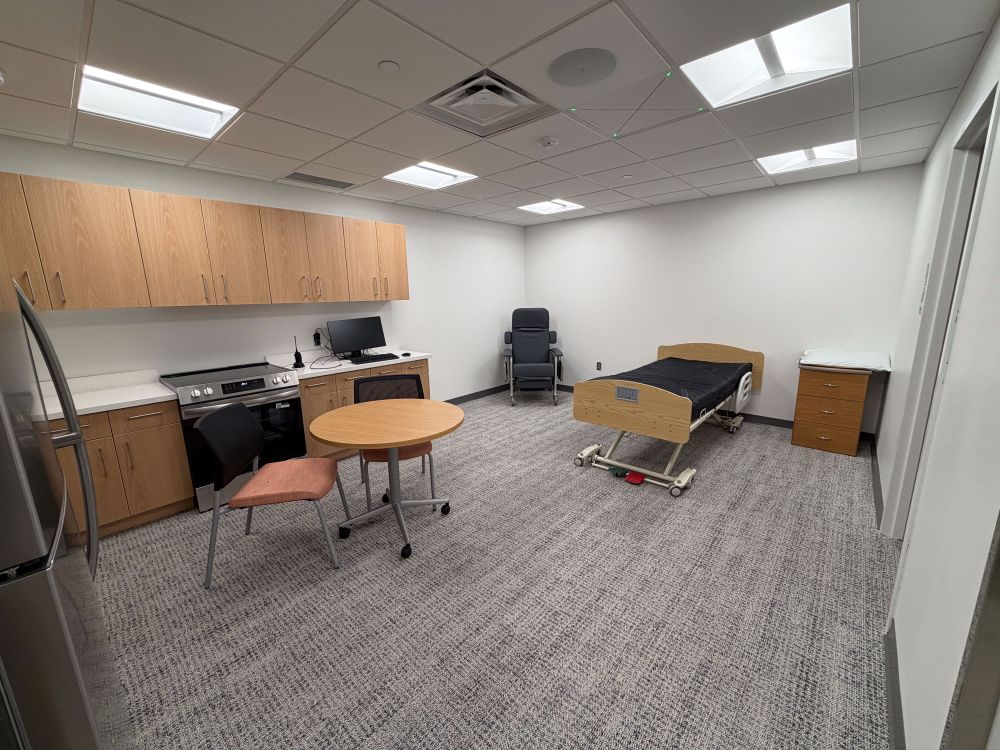 A common experience in two-year Nursing programs, is having to constantly change over existing Nursing Lab spaces to simulate different hospital and healthcare scenarios. In talking to industry partners, Normandale heard that being able to plan out pre-existing spaces for some of these scenarios would be beneficial to students in a number of ways.
Two areas where this emphasized are the Home Health Room and Labor and Delivery Flex Lab.
The Home Health Room is an area that is set up like an apartment, and has open space with a bed (with a manikin), a kitchenette and a bathroom setup. This helps students have an opportunity to experience scenarios of how to work with a client in a home setting.
“This is a good space for interprofessional curriculum and scenarios,” said Dr. Traylor. “For example, you might have an exercise science and nursing student working with a patient on mobility and running through possible scenarios. Having this space is a very unique opportunity for us. Usually, you have to convert an existing space that ends up being multiple setups. That can be time-consuming and a great deal of physical effort to transform. To have this space readily available is extremely beneficial.”
Right off of the Ambulatory Simulation Space, there is a Labor and Delivery Flex Lab. The lab has a birthing manikin which can do any sort of birthing scenario from normal birth, to traumatic birth and a C-section. This lab also has its own control room that can provide space for a small group or an individual simulation. It can also be used as another regular-simulation space.
“Maternal obstetrics (OB) is a required part of the nursing curriculum, but not many two-year programs have a dedicated simulation space,” said Dr. Traylor. “It is one of the areas that is hard to get for clinical because it is such a specialty area. Our Labor and Deliver space will have a birthing bed because that bed is different. It also has bassinet for the baby. It will be unique for our program to have a dedicated labor and delivery simulation space that doesn’t need to be shifted around.”
Unique Technology Learning Features
Along with the flexibility of the spaces, Normandale is also excited about the learning technology that will be incorporated into the Center for Interprofessional Education in Healthcare. Two of the pieces of technology include the Anatomage Table and the Virtual Reality Room.
The Virtual Reality (VR) Room has a monitor on the wall, a computer station, and is big enough for four students plus a facilitator. Each student will have VR goggles and two-handheld controllers. They will be doing scenarios similar to what they do with manikins, only in a virtual reality setting.
“The company we went with has several scenarios that are easily adaptable to interprofessional education subject matter,” said Dr. Traylor. “We think this will be a great way teach the interprofessional curriculum and scenarios, and I am excited about the learning opportunities his space can provide. The company is also actively working on a variety of scenarios that will include all of the specific health science fields.”
The Center will have Wellness room that can be converted from a classroom and all of the tables are movable and storable. The room will also have an Anatomage table, which is a life-sized, high-tech touch screen system used to study human anatomy. It displays 3D digital bodies made from real people. You can view the different layers of the body from the skin, the tissue, the muscle, to the bone, and see the vessels and nerves too. The table is an interactive tool, and students can touch the screen, move things out of the way, and pull up different scenarios.
“The Anatomage table is an excellent visual learning tool,” said Dr. Traylor. “There are a number of ways the health sciences areas can use this tool, and we could see this benefitting other academic areas of the college in the future too. There is definitely a lot of potential for this tool in interprofessional education and so many other areas.”
Planning ahead for an interprofessional learning space
The interprofessional curriculum is being taught in a number of ways at two-year colleges. However, one of the biggest benefits of building this facility is thinking ahead to how the curriculum and learning concepts can be incorporated into the facility on the front end.
“It is a great opportunity for us to be able plan out the curriculum, and think ahead to what it can be in the new space,” said Dr. Traylor. “As I talked with our faculty about having the space this fall, we discussed what the rooms will have and how they can be used. This is a unique opportunity, and without having this space so well-planned out we would have to do this in a different way.
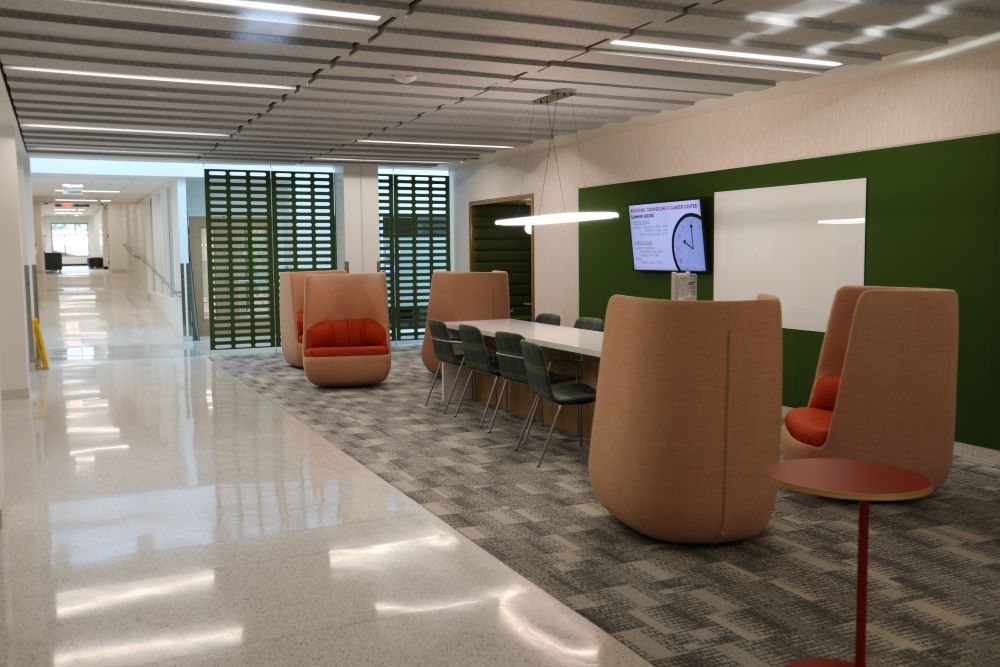 Along with so many flexible spaces and great technology, Normandale is intentionally planning an interprofessional education day where students will be in small groups in the cross-functional areas and have the opportunity to use the areas to run through interprofessional scenarios. These interprofessional days and the day-to-day opportunity to learn in this space will allow Normandale to continue to build off historically strong health science programs, and prepare students to excel in the healthcare workforce after they graduate from their programs.
“When we were designing and planning this space, we reached out to programs in different areas of the country that were doing similar work in interprofessional education,” said Dr. Traylor. “It was extremely helpful to hear what they were doing logistically in interprofessional education, what activities they had done and what the outcomes were showing. it is a very unique opportunity for a two-year institution, and we are excited about the quality learning spaces we have built and dedicated to prepare our students for the workforce. “
As the Center for Interprofessional Education in Healthcare moves forward this fall semester, it represents far more than a new collection of classrooms, labs, and technology. It is a long-term investment in student success, workforce readiness, and the future of healthcare education. By creating one of the nation's few interprofessional education centers at a two-year college, Normandale is expanding access to high-quality healthcare training while preparing graduates to collaborate, communicate, and provide exceptional patient care from day one.
 top
top