
When most students begin college, they're preparing to leave high school behind. For Elliott Tanner, college came first.
Eight years ago, Elliott arrived at Normandale Community College as one of the youngest students in the college’s history. After his parents met with Normandale's Mathematics Department Chair and Dean of STEM, they found a college community willing to look beyond his age and focus on his potential. They also saw that Normandale understood Elliott's unique educational needs and welcomed him with open arms.
 Just three weeks after his ninth birthday, Elliott began attending classes full-time on campus, starting an educational journey that would take him from Normandale's mathematics classrooms to advanced physics research aimed at uncovering the mysteries of dark matter.
Today, Elliott is completing his Ph.D. in Physics at the University of Minnesota-Twin Cities, where he works with an international research collaboration seeking answers to one of the universe's greatest mysteries. Looking back, he credits Normandale not only for challenging him academically, but for giving him an opportunity few institutions would have considered.
Before his time at Normandale, Elliott had quickly discovered that traditional educational settings were not moving at the pace he needed.
“I just couldn't quite fit into any ordinary schooling system,” he said.
After spending time in a Spanish Immersion School and later being homeschooled through increasingly advanced mathematics courses, Elliott reached a point where college-level coursework made more sense than waiting years for traditional educational pathways to catch up.
What happened next would shape the course of his life.
Normandale saw not just a young student, but a student ready to learn. The support Elliott received from faculty and administrators allowed him to pursue challenging coursework in an environment where he could thrive academically while still being a child.
“It was a great experience,” Elliott said. “I'm glad that they were happy to let me take classes when I was so young.”
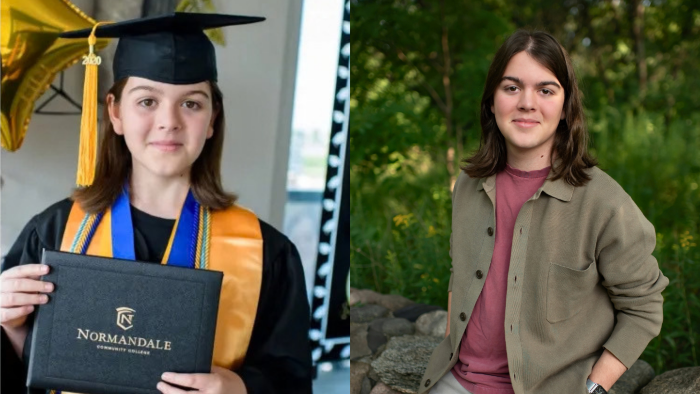
 The opportunity Normandale provided set the stage for a series of remarkable academic achievements. In May 2020, Elliott graduated from Normandale at just 11 years old, earning an Associate of Science degree in Mathematics with High Honors and a 4.0 GPA.
After transferring to the University of Minnesota-Twin Cities College of Science and Engineering, he earned a Bachelor of Science degree in Physics with a minor in Mathematics in May 2022 at age 13.
In December 2023, Elliott completed his Master of Science degree in Physics from the University of Minnesota at just 15 years old.
Now, while putting the finishing touches on his doctoral research, Elliott remains remarkably humble about accomplishments that have drawn attention across Minnesota and beyond. Rather than focusing on milestones or records, he speaks most enthusiastically about learning, problem solving, and the pursuit of knowledge.
Among Elliott's favorite memories of Normandale were the close connections between faculty members and students.
“The class sizes are smaller,” he said. “The professors can more easily talk to one another.”
He particularly remembers a program that linked introductory calculus and physics coursework, allowing instructors to coordinate lessons and help students better understand the relationships between the two subjects. That experience would prove transformative.
Although Elliott originally planned to pursue mathematics and ultimately earned his associate degree in the field, an introductory physics course sparked a new passion.
“It was basically only after I started taking the physics class that I decided to switch to physics,” he said. What began as a requirement soon became a career path.
Following his graduation from Normandale, Elliott continued his education at the University of Minnesota, where he earned both his bachelor's and master's degrees before advancing to doctoral studies.
Throughout that journey, he remained close to home. “I think the Twin Cities are a good place for education,” he said. “It's a very nice community here.”
 That sense of community, first experienced in a college setting at Normandale, continued through his time at the University of Minnesota and helped support his academic growth.
Today, Elliott's research focuses on one of physics' most compelling unanswered questions: What is dark matter?
As part of the SuperCDMS collaboration, he works alongside an international team of scientists searching for evidence of dark matter using an array of detectors located approximately two kilometers underground in Canada.
His work centers on data analysis, helping researchers understand where interactions occur within detectors and developing methods to distinguish potential dark matter signals from background noise.
“We end up collecting a lot of data,” Elliott explained. “One of the things that we need to do is learn from the data we get.”
More recently, his research has focused on developing sophisticated techniques that allow scientists to test their analysis methods without introducing bias, improving confidence in any future discoveries.
While the science is complex, Elliott clearly enjoys the challenge of tackling difficult questions and contributing to a field that pushes the boundaries of human understanding.
Despite a demanding research schedule, Elliott makes time for hobbies that combine creativity and problem-solving. He enjoys recreational computer programming and once spent countless hours working through Project Euler, a collection of mathematical and programming challenges designed to test logic and ingenuity.
“At some point, they were so fun that I eventually kind of had to quit them because I couldn't stop thinking about them,” he said with a laugh.
Looking back, Elliott's advice to current Normandale students is simple. “Take some amount of time to smell the roses,” he said. “Don't get caught up entirely in classwork and grades.”
It's wisdom earned through years of academic achievement and one that applies whether a student begins college at 18 or, in Elliott's case, at nine.
As he looks toward the completion of his Ph.D., Elliott is considering a future in higher education and hopes to one day become a physics lecturer, sharing his passion for science with future generations of students.
Reflecting on his time at Normandale, his gratitude remains clear.
“It was a great experience,” he said. “I'm glad that they were happy to let me take classes when I was so young.”
For Normandale, Elliott's story serves as a powerful reminder that talent can emerge at any age and that extraordinary futures often begin when educators are willing to provide support, and help open doors. What started with one young student walking into a college classroom has grown into a journey that continues to expand our understanding of the universe itself.
 top
top